
Binder Identification.
Your peptide library screened against the target protein. A bound-or-not call for each peptide, with statistical confidence.
What it answers
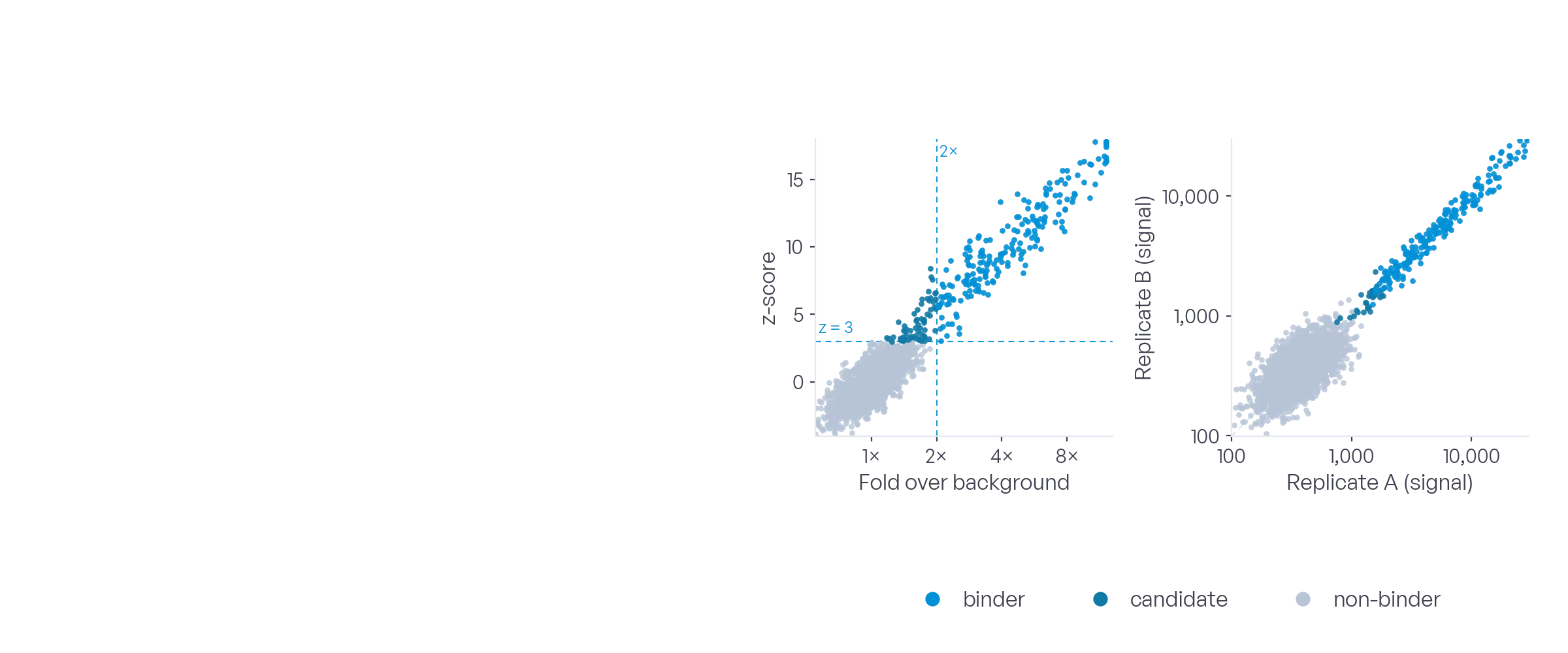
Which peptides of my library bind the target protein? We synthesize the test library in situ, up to 200,000 peptides per microarray, incubate it with the target protein and measure binding for every peptide. The result is a ranked table: each peptide bound or not, with the fold over background and the confidence of the call.
When to use it
AI-designed binder validation
Test every candidate the model proposed, not a hand-picked dozen.
Training data
Thousands of confirmed binders and non-binders from one experiment, labeled for your model.
Lead optimization
Substitution scans, truncations and combinatorial variants of a lead peptide show which residues carry the binding and which positions tolerate change.
Off-target screening
A peptidome library, fragments covering a whole proteome, shows which other sequences the target protein recognizes. A panel of proteins in separate wells shows which of them bind your library.
How the assay works
Day 0
1Project submission
Configure the library and submit the project by email.
Day 1–7
2Peptide synthesis
Your peptides are synthesized in situ on the microarray: up to 200,000 peptide spots per microarray, along with blank spots and synthesis controls.
Day 8–10
3Bioassay
The microarray is scanned before the target protein is added, incubated with the labeled protein in one to 18 wells, and scanned again. The reference scan and the blank spots define the background of every peptide.
Day 11–13
4Data analysis
The replicates of each peptide are tested against the background. A z-score and a false-discovery rate give the confidence of the call; the fold over background is reported with it.
Day 14
5Project release
Raw data, processed results and the project report are released to you.
What you provide
Sequences
A list of sequences, including custom building blocks: unnatural or D-amino acids, cyclization by thioether, disulfide or amide. Or a library we derive from your sequences or a protein structure. Up to 25 residues per peptide.
Target protein
Purified. Labeled by you with a fluorophore or biotin, tagged for detection with a secondary antibody, or labeled by us. Amount and buffer are confirmed in the quote.
Assay conditions
Optional. Preferred buffer, concentration, temperature and controls. Otherwise we propose them in the quote.
What we deliver
Raw data
Scanner exports and extracted signals for every spot.
Processed results
Peptide summary, spot data and specificity table: signal, fold over background, z-score, false-discovery rate and the call for every peptide. Spreadsheet and CSV.
Project report
Design, protocol, quality control, ranked results with figures, motif analysis and a data dictionary.
From a real project
Which residues of a lead peptide carry the binding?
- Question
- A biotech customer had one lead peptide for a cell-surface receptor and needed a structure–activity map before optimizing it.
- Design
- About 100,000 14-residue variants of the lead on one microarray, in duplicate: every single substitution, combinatorial variants, truncations, fragments and scrambles. The biotinylated receptor ectodomain at two concentrations, two rounds on the same microarray.
- Result
- The lead ranked 7th of about 98,000 peptides, and about 3,500 variants bound at both concentrations. Alanine substitutions located the binding in a seven-residue N-terminal core, which bound as a fragment on its own. The C-terminus was dispensable.
| Peptide | Sequence | Signal | Fold | z-score | FDR | Class |
|---|---|---|---|---|---|---|
| PEP-00017 | GRWSAFNVPKLMEQ | 9,842 | 4.1× | 12.6 | 3e-19 | bound |
| PEP-00018 | GRWSAFNVPKAMEQ | 8,115 | 3.4× | 10.9 | 8e-16 | bound |
| PEP-00019 | GRWSAFNAPKLMEQ | 2,930 | 1.2× | 2.1 | 0.24 | not bound |
| PEP-00020 | GRASAFNVPKLMEQ | 612 | 0.3× | -1.4 | 0.91 | not bound |
| PEP-00021 | NRWSAFNVPKLMEQ | 6,470 | 2.7× | 8.3 | 2e-11 | bound |
| PEP-00022 | GRWSGFNVPKLMEQ | 3,210 | 1.3× | 3.2 | 0.04 | bound |
Excerpt of the results table. Generic records, real columns.
Questions
Can the library contain unnatural amino acids or cyclic peptides?
Yes. Any commercially available Fmoc-protected amino acid with a free carboxyl group, sourced per project, including D-amino acids. Cyclization by thioether, disulfide or amide. Up to 25 residues. Stabilizing modifications are tested in the same run as the unmodified sequence.
Do I need to label my protein?
No. Send it labeled with a fluorophore or biotin, tagged for detection with a secondary antibody, or let us label it. Amount and buffer are confirmed in the quote.
How do you decide that a peptide is bound?
Each peptide is compared with blank spots and with a scan taken before the target protein is added. It is called bound when its replicates lie significantly above that background, reported as a z-score and a false-discovery rate. The fold over background is reported with it.
Does a stronger signal mean a stronger binder?
Not reliably. An end-point signal depends on synthesis yield and off-rate as much as on affinity. To rank binders, add KD Ranking: a concentration series on the same microarray gives an apparent KD for every peptide.
Peptide array or phage display: which fits my question?
They answer different questions. Phage display, like mRNA display, selects from a random library far larger than any array and returns the sequences enriched over the selection rounds. It is the better choice when there is no starting sequence and you need a binder from scratch. A peptide microarray tests a library you define, up to 200,000 peptides per array, and measures every peptide, binders and non-binders alike. It fits when the candidates already exist: designed by a model, variants of a lead, or tiles of a protein sequence. Many programs use both: display to find a hit, the array to map and optimize it.
How large can a project be, and how many conditions fit on one microarray?
Up to 500,000 peptides per project from 14 days, on three microarrays in parallel; larger projects on request. One microarray holds from one condition with 200,000 peptides to 18 conditions with 3,200 peptides each: proteins, concentrations, buffers or controls.
Can the library cover a whole proteome?
Yes, up to one, within the project's capacity. The proteins are sliced into peptides, and each peptide is annotated with every protein it occurs in. A binding peptide then points to all the proteins that carry its sequence, which turns the screen into an off-target search. Filters keep a large proteome within capacity.
Bring your target and your question
We will propose a library, a layout and a timeline within one business day.